
Sleep psychology kicks me to sleep MD
Over the past 19 months, I’ve been working periodically with a sleep psychologist. It’s worked great; in fact, I’ve mastered CBT-I. But, my subconscious brain does not want to sleep very long, and naps just haven’t happened for several months now.
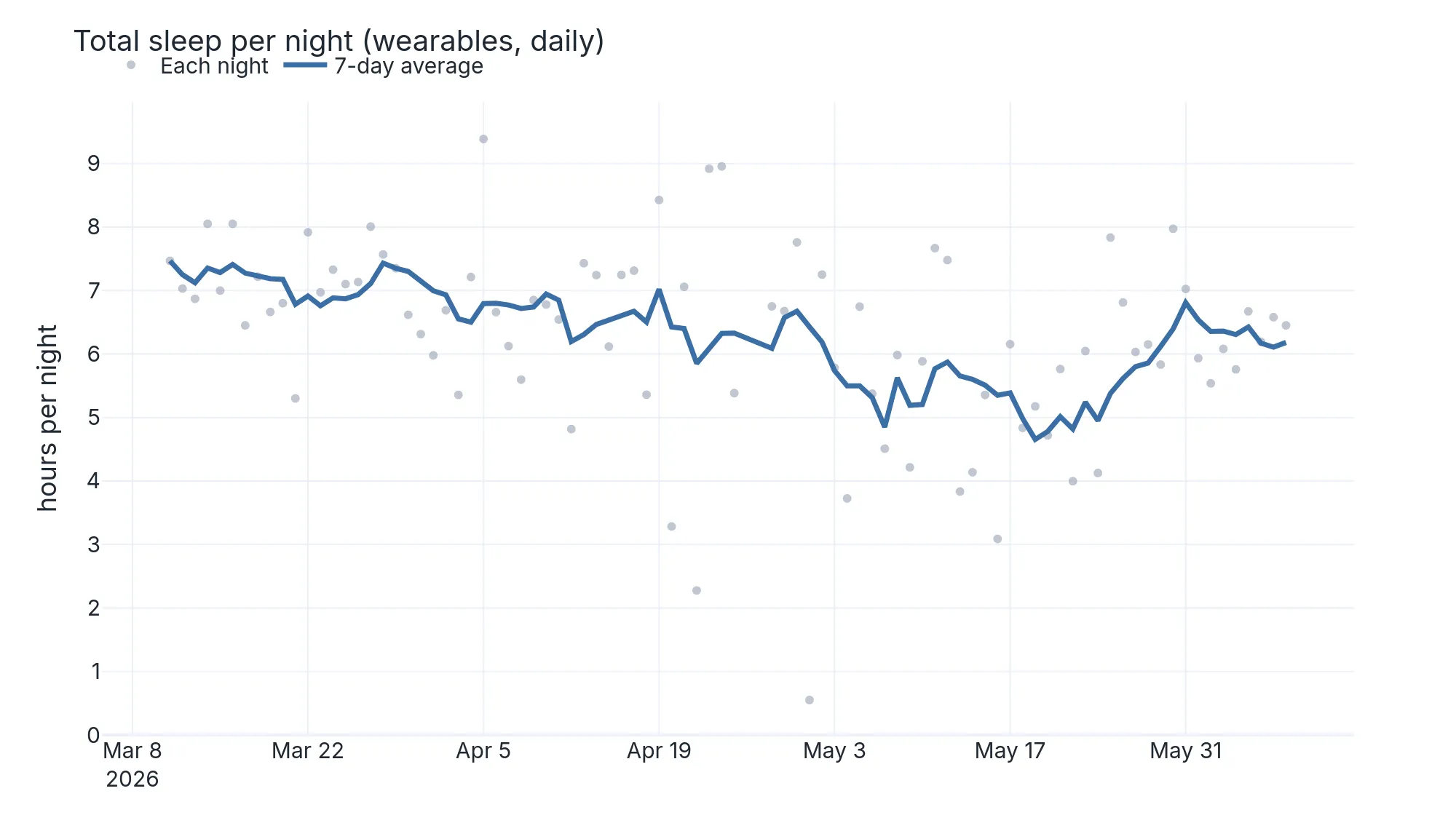
I have a sleep doctor appointment coming up, and I also track it with wearables. I pulled every night on my Oura ring and Garmin watch have recorded, and am sharing it here.
The wearables don’t agree perfectly, and neither one is a sleep study. But two devices measuring the same nights, averaged together, paint a consistent picture — and it’s pretty awful.
The shape of a bad sleeper

Here are the last three months, by window:
| Metric | Last 30 | Last 60 | Last 90 |
|---|---|---|---|
| Total sleep | 5h 57m | 5h 46m | 6h 07m |
| Efficiency | 86% | 83% | 86% |
| Time to fall asleep | 13 min | 15 min | 15 min |
| Deep | 1h 04m | 1h 06m | 1h 19m |
| REM | 1h 06m | 1h 00m | 1h 07m |
| Awake | 1h 05m | 1h 16m | 1h 05m |
| Overnight HR | 51 bpm | 50 bpm | 49 bpm |
| HRV | 23 ms | 25 ms | 26 ms |
| SpO₂ | 96.2% | 96.3% | 96.3% |
The recent trend is still the wrong direction: across most rows the 30-night window is worse than the 90-night one. Less total sleep, less deep sleep, and an HRV sliding from the mid-20s into the low 20s. Falling asleep isn’t my problem—13 minutes is fine. Staying asleep is more than an hour awake most nights, after I’ve already drifted off.
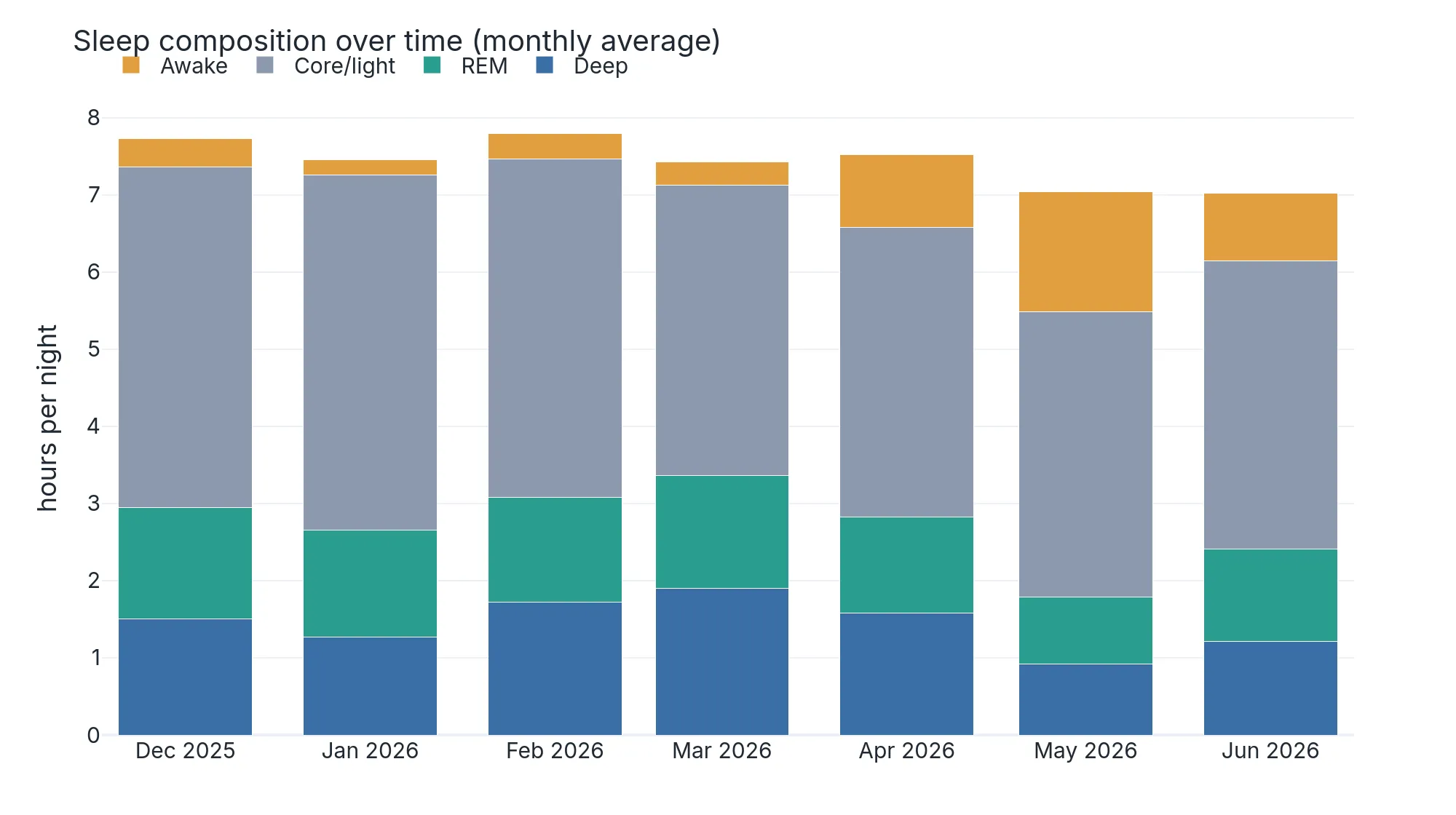
Stack it up by stage and the deep-sleep erosion is the part that worries me. Deep sleep is where the body does its repair work, and mine has been thinning out month over month.
The part I’m actually bringing to the doctor
The reason I wanted a sleep doctor in addition to the psychologist who was out of ideas—and not another app that tells me to avoid screens—is the breathing data. My overnight blood oxygen looks reassuring at a glance: it averages 96.3% and the nightly average stays above 95% on all but two recent nights (94.5% and 94.3%). No dramatic desaturations. So if this were straightforward obstructive apnea with oxygen crashing all night, it isn’t showing up that way.
But Oura’s breathing-disturbance index tells a noisier story. It averages a low 4, yet on 13 of the last 73 nights it climbs to 8 or higher, spiking as high as 15. Those disturbed nights don’t line up with low oxygen — they line up with the fragmented, low-deep-sleep nights above. That’s the question I’m handing the specialist: not “am I desaturating” (I don’t seem to be), but “why is my breathing this restless on a third of my nights, and is it what’s pulling me out of deep sleep?”
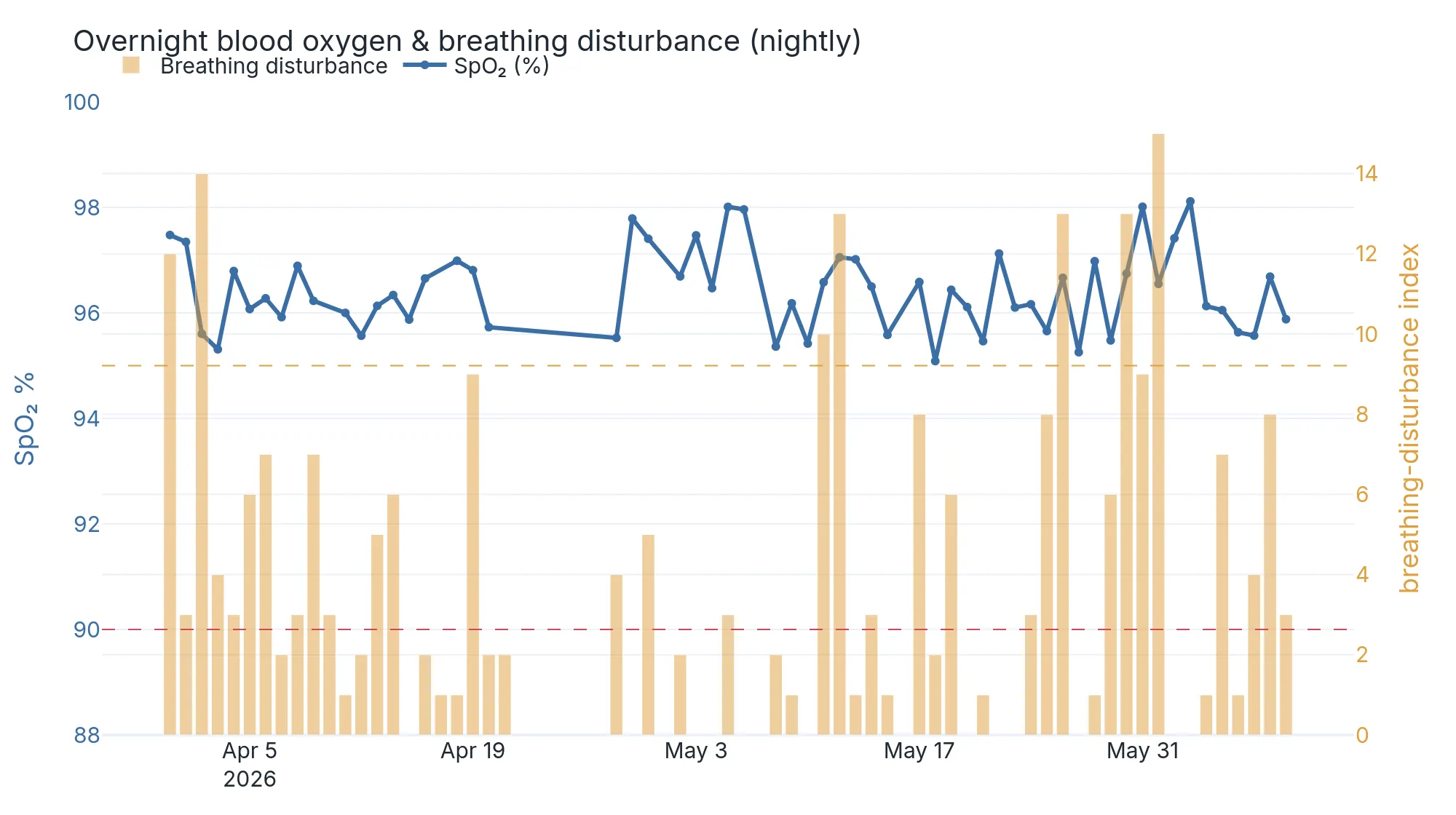
It’s worth naming what this isn’t: a polysomnogram. A consumer Oura ring estimating respiration from the back of my finger is not an apnea diagnosis, and the breathing-disturbance index isn’t an AHI. But it’s 90 nights of my own bed instead of one wired night in a lab, and the pattern is consistent enough that I want a real test to confirm or rule it out.
The current stack
For completeness — and because every specialist asks — here’s what I’m taking at night right now:
| Agent | Dose | Why |
|---|---|---|
| Mirtazapine | 15 mg | Sleep (and appetite) |
| Night Rest + melatonin | 2 tablets | 5 mg melatonin, 300 mg Mg, 500 mg GABA |
| L-Theanine | 400 mg | Sleep, anxiety |
| Glycine | 3 g | Sleep |
| Ashwagandha (root + KSM-66) | 1 each | Sleep, anxiety, HRV |
| Guanfacine ER | 2 mg | Sleep, attention (paired with NAC, Yale LC study) |
| Hydroxyzine | 50 mg | Insomnia |
| Charlotte’s Web Sleep CBD gummies | 1 gummy | CBD + CBN + melatonin |
That is, frankly, a lot of scaffolding to hold up six hours of mediocre sleep. Part of what I want out of this appointment is permission to take some of it away — to find out which of these is doing real work and which I’m taking out of nineteen months of desperation.
What I’m hoping for
Yet another sleep study, probably. An answer to the breathing question, ideally. And—selfishly—a doctor who looks at the same charts I’m looking at and says yes, that’s abnormal, here’s the next test, instead of your numbers look fine. I’ve heard “fine” enough.
All figures here are nightly means of whichever of my Oura ring and Garmin watch recorded that night — consumer wearables, not clinical-grade instruments. Generated from my own health export; nothing here is medical advice.
In other neurological news
More migraine medications to help with a problem I’m not that worried about (I already take Emgality, and it helps minimize migraines). Also, taking medication for elevated labs that could (or probably not) be myasthenia gravis.